How Theater and Storytelling Help Young Learners on a Journey of Self-Discovery
By Emma Sorkin
If you ask Librarian Abbey Mather, education revolves around stories. “Education is the story we tell ourselves about our role in the world and about our relationship to the past,” she says.
For young learners, education often begins with picture books full of vivid imagery, transforming classrooms into magical worlds as compelling characters leap off the page.
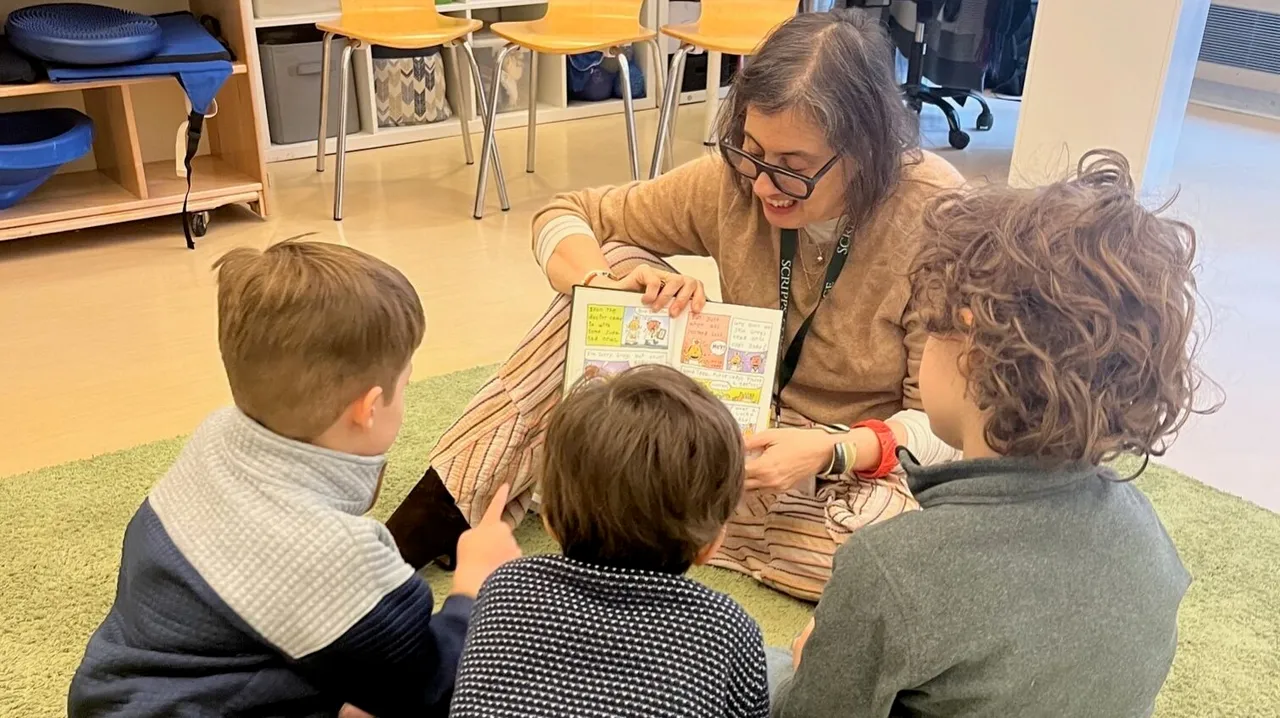
Through an integrated Library and Theater storytelling class for students in Kindergarten and first grade, Abbey and Theater Teacher and Lower School Arts Integration Coordinator Joanne Magee harness the power of stories to fuel a new type of self-discovery.
Each class begins with the same routine in the theater classroom: circle time and warm-up followed by group story time, a book often relating to a cultural theme or topic that aligns with the students’ academic courses. Throughout the read-aloud, theatrical elements peek through as students are encouraged to personify different characters.
“We are finding that books are the gateway to self-expression in theater. Using picture books with diverse characters, settings, and dramatic plots serves as a bridge from page to stage. Creativity blooms when stories are read and enacted. We are expanding students' skills to be deep thinkers, orators, and actors. We encourage speaking the voices, acting the gestures of the characters, and reflecting on how the pages express so much more than words through images, artistry, and style,” Joanne says.
After the read-aloud, students head to the library. With its carefully curated book collection and cozy atmosphere, the library encourages young readers to dive deeper into their areas of interest while simultaneously uncovering new passions and laying the foundation for a lifelong love of literature.
Once students have time to check out their library books, it’s time to bring the stories they’re reading to life. For younger twice-exceptional students in particular, this combination of reading and acting presents a unique opportunity to think both critically and collectively.
“We have a whole group of students who are hyperlexic, and for them, the experience of slowing down, listening, and reflecting on what they're doing, both through theater and discussing the books, is hugely important. It's nice for them that this is a group experience because it's really good practice in joint attention. They're doing the same thing and building up a shared vocabulary and imaginative space. For our students who struggle with reading, it brings them up because it provides a more sophisticated experience while building their skills,” Abbey says.
Through combining library and theater, students who may not identify as strong or passionate readers still have the opportunity to build their confidence.
“The richness of the program is unmatched. There's something very deep about every individual child, even if they didn't see themselves as readers, reading a character line, and then the next time reading a bit more, and then the next time getting more and more confident. They'll go back to their classroom having just had this experience where they're like, ‘Well, I just read that in the library out loud, and we just acted that out, so I'm a stronger reader.’ We're not teaching explicit reading skills, but it's implicitly being developed every second they're with us,” Joanne says.
Building literacy skills as a result of combining theater and storytelling is just the beginning. Embodying different character roles encourages students to take on new perspectives.
Through collective storytelling, students also develop the tools needed for self-advocacy.
“We’re basically beginning in Kindergarten the journey of self-actualization, which is something many of us don’t get to do until we’re adults,” Joanne says.
These skills will serve even the youngest students well beyond the classroom.
“We're giving the students the tools to tell whatever story they want to tell about themselves and their lives and their interests,” Abbey says. “What I really want to give to them is the ability to understand that they can narrate their existence however they want. For our kids in particular, I want them to know that they have the tools to make choices about how they're presenting themselves in the world and what they're pursuing in the world.”

A not-for-profit independent college preparatory school, Quad Prep’s rich and robust curriculum engages, challenges, and inspires students at all levels, K–12, through our Lower School and Upper School programs. Quad Prep does not discriminate on the basis of race, color, religion, sex, gender identity or expression, sexual orientation, national and ethnic origin, ancestry, age, marital status, disability, or any other characteristic protected by law. This policy applies to, but is not limited to, educational policies, admission, financial consideration, hiring and employment practices, use of school facilities, athletics, and other school-administered programs.